
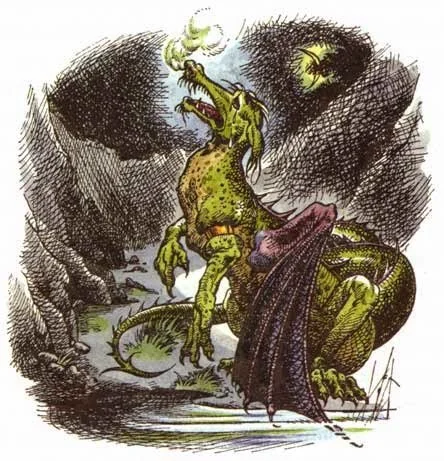
In the fourth book of The Chronicles of Narnia, The Voyage of the Dawn Treader, we are introduced to Eustace Clarence Scrubb, a boy whose character matched his odd and disturbing name. He was a brattish killjoy who was consumed with selfishness. The wake of his narcissism infected every circumstance he encountered and every relationship he had.
While lost hiking on a mysterious island, he settled down for rest and fell asleep in a dragon’s lair only to awaken transfigured into a dragon himself. Consumed by self and greed, he had morphed into a beast as he slept. Terrified, Eustace began a long journey of self-awareness that led to a deep inner transformation. Over time and by grace, he met the great lion Aslan (the Christ figure in the Narnia tales) who tells Eustace to undress himself. Three times, the dragon tries to peel away his own reptilian skin only to discover another layer. Lewis describes what happens next in the undragoning of Eustace:
Then the lion said - but I don’t know if it spoke - “You will have to let me undress you.” I was afraid of his claws, I can tell you, but I was pretty nearly desperate now. So, I just lay flat down on my back to let him do it.
The very first tear he made was so deep that I thought it had gone right into my heart. And when he began pulling the skin off, it hurt worse than anything I’ve ever felt. The only thing that made me able to bear it was just the pleasure of feeling the stuff peel off. You know - if you’ve ever picked the scab of a sore place. It hurts like billy-oh but it is such fun to see it coming away.
Well, he peeled the beastly stuff right off - just as I thought I’d done it myself the other three times, only they hadn’t hurt - and there it was lying on the grass: only ever so much thicker, and darker, and more knobbly-looking than the others had been. And there was I as smooth and soft as a peeled switch and smaller than I had been. Then he caught hold of me - I didn’t like that much for I was very tender underneath now that I’d no skin on - and threw me into the water. It smarted like anything but only for a moment. After that it became perfectly delicious and as soon as I started swimming and splashing, I found that all the pain had gone from my arm. And then I saw why. I’d turned into a boy again.
Eustace was transformed by Aslan who did for Eustace what he could not do for himself. He turned him from a beastly dragon into a young boy again. Aslan “peeled the beastly stuff right off.” He experienced the blessedness of Jesus who taught “God blesses those who are poor and realize their need for him, for the Kingdom of Heaven is theirs.” Broken, needy, desperate and alone, Aslan alone could strip off Eustace’s dragon hide.
John Ortberg describes the first three steps of Alcoholics Anonymous this way. “I can’t. God can. I think I’ll let him.” (Steps by John Ortberg) The recovery community gets the coupling of the gift of desperation (“You will have to let me undress you.”) with a surrendering to God and his ability to do for us, what we cannot do for ourselves (So, I just lay flat down on my back to let him do it.) This is when the miracle of recovery begins.
But these are just the first three of the Twelve Steps. The remaining nine steps give us the tools to fix our relationship with ourselves and our relationships with others as well as the ongoing tools to help us keep our contact with God strong, our self-awareness sharp and our relationships with others well. Lewis captured the “already and not yet” of Eustace’s transformation when near the end of the chapter, he writes this about boy who used to be a dragon:
It would be nice, and fairly nearly true, to say that “from that time forth Eustace was a different boy.” To be strictly accurate, he began to be a different boy. He had relapses. There were still many days when he could be very tiresome. But most of those I shall not notice. The cure had begun.
I love it! “He began to be a different boy.” Truer words have seldom been written. Our undragoning is just the beginning of Jesus’ work in us. The cure had begun.