
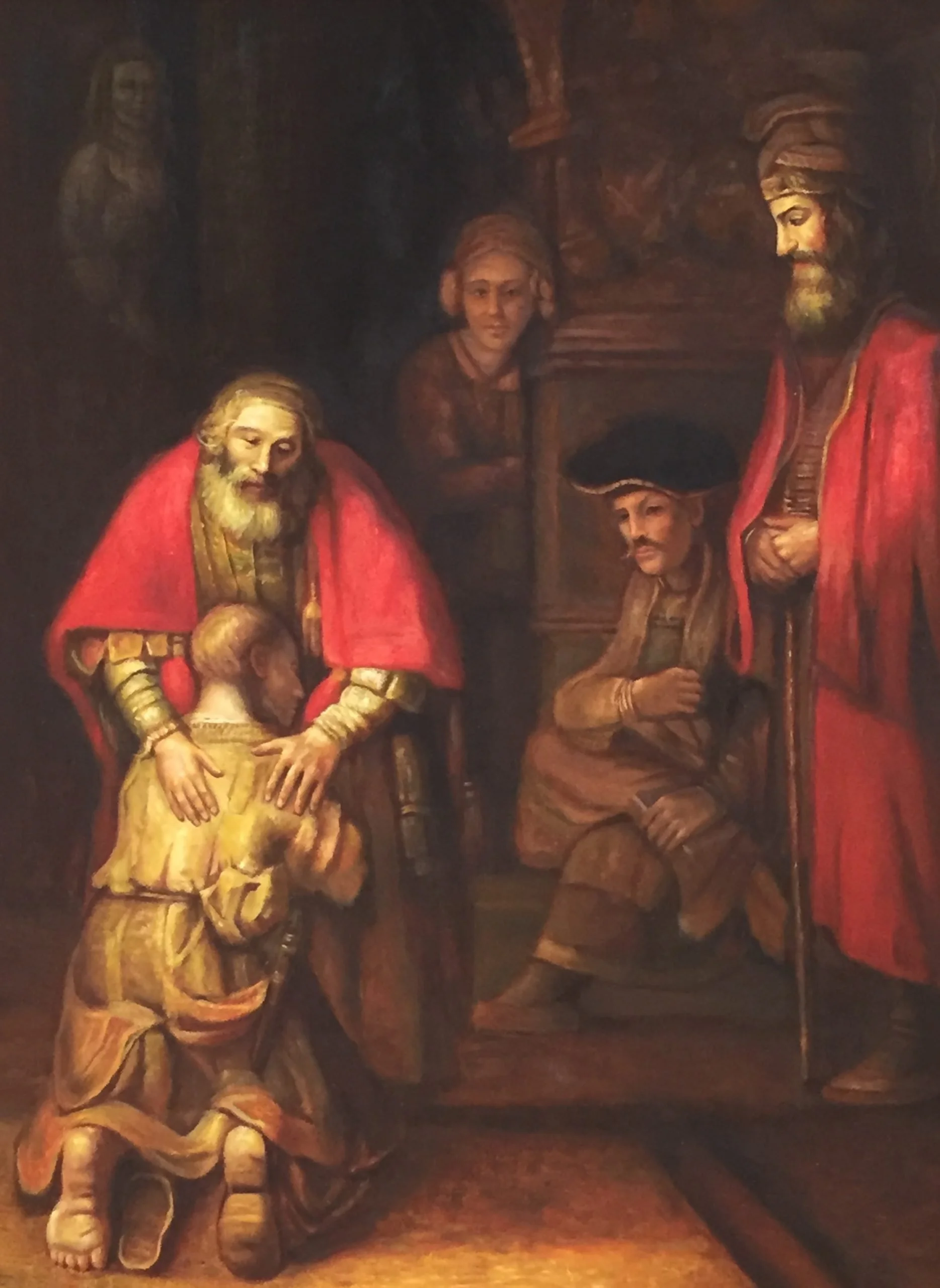
My assigned Bible text for this Sunday morning was Luke 15:11–32, the last of Jesus' "lost and found" parables. It's the emotional story of two very different boys and their kind, patient father. As the dad of two boys, Daniel and Nathan, I've always felt the punch of this story. This morning I prayed for fresh insight, and the Spirit led me to notice the character and actions of the father. I've heard Bible teachers call him "the prodigal father." The word "prodigal" means "wastefully extravagant," and the father in Jesus' story answers his younger son's wasteful living with a radically different kind of extravagance: abundant generosity toward both of his precious boys. So I made a list of eight things the text says about this prodigal dad.
The prodigal father…
1. …was filled with love and compassion for his younger son.
2. …ran to his younger son.
3. …embraced his younger son.
4. …kissed his younger son.
5. …gave a robe, a ring and sandals to his younger son.
6. …threw a party for his younger son.
7. …pleaded with his older son to join the celebration.
8. …affirmed his love for his older son.
As I made the list, the Spirit reminded me of the wisdom of Henri Nouwen in his classic book The Return of the Prodigal Son, which I reread earlier this year. Nouwen wrote it as a reflection on Rembrandt's painting of the same name. The first time I read it, I expected to be challenged to reflect on my own spiritual journey in light of the recklessly foolish younger son and the harsh, judgmental older son. What I did not expect was that Nouwen would take this personal examen one dangerous step further. He had the gentle audacity to say that in this parable Jesus challenges us to embrace and emulate the character of the father. Nouwen writes:
What I am called to make true is that whether I am the younger or the elder son, I am the son of my compassionate Father. I am an heir. No one says it more clearly than Paul when he writes: “The Spirit himself joins with our spirit to bear witness that we are children of God. And if we are children, then we are heirs, heirs of God, and joint heirs with Christ, provided that we share his sufferings, so as to share his glory." Indeed, as son and heir I am to become successor. I am destined to step into my Father's place and offer to others the same compassion that he has offered me. The return to the Father is ultimately the challenge to become the Father.
Henri Nouwen, The Return of the Prodigal Son, 123
Let this settle in. Pause for a moment. Place your hand on your heart. Close your eyes and hear it again: "The return to the Father is ultimately the challenge to become the Father."
He's right. As image bearers rescued and redeemed by God's "vulgar grace" and "indiscriminate compassion," we are invited to embody the Father's prodigal character in our everyday lives. This side of heaven, as "joint heirs with Christ," we can become women and men filled with love and compassion: people who run to prodigal sons and daughters (even when the prodigal is ourselves) and restore them as children of God and persons of worth. We can be the ones who throw parties to celebrate homecomings, pleading with even God's angry children to join the festivities. As apprentices of Jesus, we have known seasons of running from our Father's house and wasting his generosity, and times of living in our Father's house without our Father's heart. Our lives need to move beyond both, until we become just like our Dad.
All this took me back decades, to a simple, lullaby-like song Amy Grant sang called "Father's Eyes." Its chorus is a prayer to become like our prodigal Father. Let it become your prayer, too.
She's got her father's eyes,
Her father's eyes;
Eyes that find the good in things,
When good is not around;
Eyes that find the source of help,
When help just can't be found;
Eyes full of compassion,
Seeing every pain;
Knowing what you're going through
And feeling it the same.
Just like my father's eyes,
My father's eyes,
My father's eyes,
Just like my father's eyes.